
Blog
How to Buy a Wardrobe in Dubai: Sizes, Configurations & Custom vs Ready-Made – 2026

Every week, someone walks into our showroom in Arjan having already made an expensive mistake. They ordered a wardrobe online, it arrived in Dubai, and it’s either 10cm too wide for the alcove, too shallow for proper hanging, or the finish is bubbling after one summer of air conditioning cycling on and off. After 20 years of building bedroom furniture specifically for UAE homes from Marina studios to Jumeirah villas we’ve seen almost every wardrobe mistake possible. This guide is here to help you avoid all of them.
Whether you’re furnishing a new apartment in Business Bay, upgrading a master bedroom in Mirdif, or fitting out an entire villa in Arabian Ranches, the wardrobe decision matters more than most people realise. It affects your daily routine, your storage capacity, and because Dubai property moves fast your eventual resale value. By the end of this guide, you’ll know exactly what size to buy, which configuration suits your needs, and whether bedroom sets or individual storage furniture is the smarter choice for your specific situation.
Understanding Wardrobe Sizes in UAE Homes
Dubai apartments and Abu Dhabi villas are not built like European or North American homes. Developers here follow their own standards, and bedroom alcoves—the recessed spaces where wardrobes typically sit—are rarely the standard sizes you’ll find quoted on international furniture websites. This is the single biggest source of frustration we see, which is why many clients prefer tailored wardrobes and cupboards to ensure every inch of their storage furniture is utilized correctly.
The most common bedroom alcove widths in Dubai range from 160cm to 280cm, with 180cm and 240cm being the most frequent in apartment developments from developers like Emaar, Damac, and Nakheel. Villa master bedrooms often run wider—300cm to 360cm—but the ceiling heights are typically higher too, often 3m to 3.4m compared to the 2.7m standard in most apartments. These differences change everything about what beds will fit and how night stands will look proportional in your space.
Standard Wardrobe Dimensions to Know
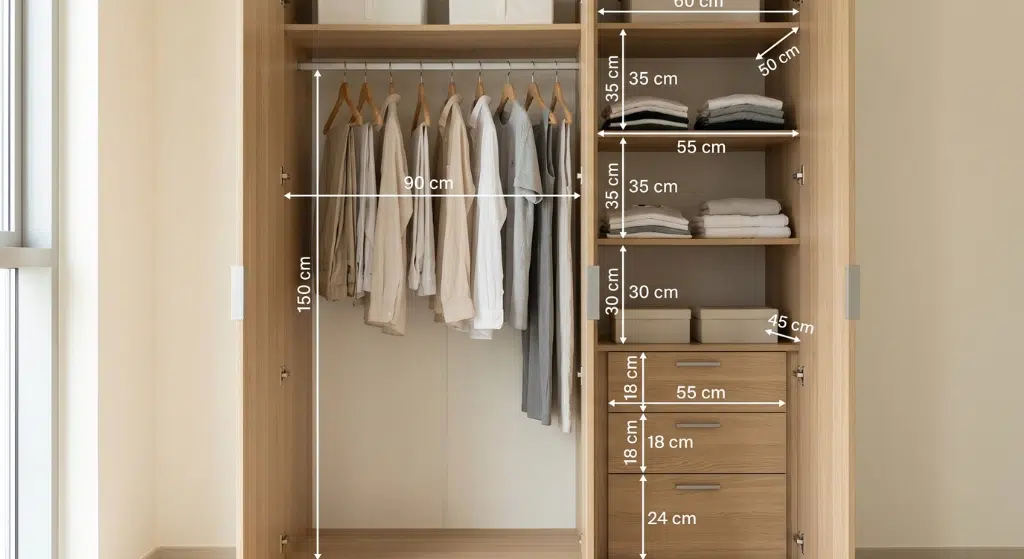
In terms of depth, 60cm is the absolute minimum for a clothes-hanging wardrobe. Anything shallower and your jacket shoulders stick out past the door frame, which looks bad and causes the doors to catch. We recommend 62–65cm finished interior depth as a practical standard for wardrobes and cupboards in UAE apartments. For walk-in configurations, you need at least 120cm of clear floor space between facing sections of storage furniture.
Height is where ready-made wardrobes fail UAE homes most noticeably. Most imported ready-made units top out at 220cm. The average Dubai apartment ceiling is 270cm. That 50cm gap at the top becomes a dust trap—and in Dubai, that matters. Dust here isn’t the light European variety; it’s fine desert particulate that settles everywhere, making it essential to choose high-quality wardrobes and cupboards. A floor-to-ceiling build eliminates the problem entirely, which is one reason custom-integrated bedroom sets are so popular in this market.
Width configurations for standard ready-made wardrobes typically come in fixed intervals: 90cm, 120cm, 150cm, 180cm, and 200cm. If your alcove is 215cm, you either leave a 15cm gap (ugly and wasteful) or you go custom to fit your wardrobes and cupboards perfectly. This is particularly important when trying to coordinate other bedroom sets within a fixed architectural footprint. More on that shortly.
Measuring Your Space Correctly A Step Manufacturers Skip
Here’s something nobody tells you until it’s too late: measure your alcove at three heights, not one. Walls in UAE buildings, particularly in older Jumeirah and Deira developments, are rarely perfectly plumb. A difference of 2–3cm from floor measurement to ceiling measurement is common. If you’re ordering a wardrobe to fit flush, you need to know the narrowest point—that’s the dimension you build to. Ensuring these tolerances are met is critical when planning bedroom sets that need to align perfectly with your walls.
Also measure the floor carefully. Tiled floors in Dubai apartments often have slight height variation, especially near walls. If you’re installing a floor-to-ceiling wardrobe, a small plinth or levelling solution at the base is often necessary. We include this assessment in every site visit we do—it’s one of those workshop-floor realities that only comes with experience, ensuring that your storage furniture stays perfectly balanced and secure.
Finally, account for skirting boards if present. Some older villas and apartments have 8–12cm skirting that eats into your depth. Either the wardrobe is designed around it, or the skirting needs to be cut, which a carpenter can do during installation but needs planning in advance to ensure all your storage furniture sits perfectly flush against the wall.
Custom vs Ready-Made Wardrobes: An Honest Comparison
This is the question we get asked most. The honest answer is: it depends on your situation, not on what sounds better in a showroom. Here’s how we think about it when helping you select between wardrobes and cupboards or fully integrated bedroom sets.
When Ready-Made Makes Sense
Ready-made wardrobes from IKEA, Home Centre, or online retailers make sense when your budget is tight, you’re in temporary accommodation, or your space happens to match standard dimensions. If you’re in a short-term rental or a serviced apartment and just need functional storage furniture, spending AED 3,000–6,000 on a decent ready-made unit is entirely reasonable.
Ready-made also works well for children’s bedrooms where the requirements will change in a few years anyway, or for guest rooms where heavy-duty daily use isn’t a factor. The key is managing expectations: ready-made furniture is built to a price point, and the materials, hinges, drawer runners, and finishes reflect that. In a humid Dubai summer, cheap MDF board with a paper-thin laminate can swell around the edges after 18 months of air conditioning running at full blast, which is why we offer more durable bunk beds and night stands designed to withstand local conditions.
When Custom Is Worth Every Dirham
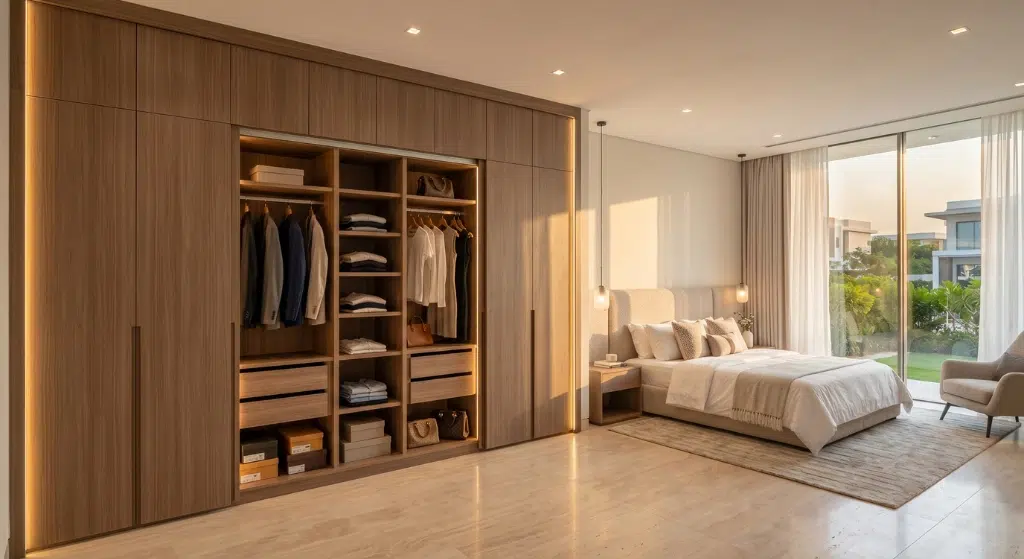
Custom wardrobes earn their cost when you’re furnishing a long-term home, when your space has non-standard dimensions (which is most Dubai homes), or when you want the wardrobe to look built-in rather than placed. The floor-to-ceiling fit alone justifies the investment in many cases not just aesthetically, but practically because it eliminates that dust-collecting gap, allowing for seamless integration with other wardrobes and cupboards and high-end bedroom sets.
From our workshop, we’ve also seen that custom interiors make a genuine daily-life difference. A ready-made wardrobe gives you fixed shelves and one or two hanging rails. A custom interior is planned around how you actually live whether that means a dedicated section for thobes and abayas (which need full-length hanging of at least 140cm), a specific arrangement for a large shoe collection, or pull-out trouser racks for someone who wears a wardrobe-integrated suit every day. This level of personalization is the hallmark of premium storage furniture.
Custom doesn’t always mean dramatically more expensive either. Because we’re a direct manufacturer no middlemen, no showroom markup on inventory we can provide high-quality wardrobes and cupboards at a price point that surprises many. By cutting out the traditional retail layers, we pass those savings directly to you, making premium bedroom sets more accessible than you might think.
Our custom pieces often land close to or only marginally above what you’d spend at a high-street furniture retailer for equivalent quality. The value comparison changes significantly once you’re looking at AED 8,000+ units, as this is where the durability and fit of bespoke wardrobes and cupboards far exceed mass-produced options. For those investing in long-term home comfort, choosing premium storage furniture ensures that your investment stands the test of time in the UAE environment.
Lead Times: What to Expect
Ready-made is immediate—same day or next day delivery in most of Dubai. Custom has a production lead time. At Kustom Deco, our standard turnaround is 15–21 working days from confirmed design and deposit. For complex built-in projects or villa fit-outs, allow 25–30 working days. During peak periods—typically September to November when people return from summer and begin home projects—add a week. If you’re planning around a move-in date, work backwards from that date and book early to secure your wardrobes and cupboards and bedroom sets.
Wardrobe Configurations: What Actually Works in UAE Bedrooms
Beyond dimensions, the internal layout of a wardrobe is where the real planning happens. Let’s walk through the main configurations and who each suits, ensuring your choice of wardrobes and cupboards or storage furniture is perfectly aligned with your lifestyle.
Sliding Door vs Hinged Door
In UAE bedrooms, sliding doors dominate and for good reason. Most master bedrooms in Dubai apartments are not large enough to swing full-width hinged doors without bumping into the bed. A standard double door on a 90cm wardrobe section swings 45cm into the room. Multiply that across a 240cm wardrobe and you’ve consumed nearly your entire circulation space, making sliding wardrobes and cupboards the superior choice for compact urban living.
Sliding doors solve the problem elegantly. They require zero clearance in front of the wardrobe, which is why they’ve become the default in apartment developments across Dubai, Abu Dhabi, and Sharjah. The trade-off is access with sliding doors, you can only access half the wardrobe at a time. For people who like to see their entire wardrobe in one glance while getting dressed, this is a genuine inconvenience.
For villa bedrooms with generous floor plans such as those in Arabian Ranches, Jumeirah Park, or Emirates Hills hinged doors are entirely practical and give a more traditional, luxurious feel. They also tend to be mechanically simpler, with fewer components to wear out over time, making them a staple for high-end wardrobes and cupboards in larger properties. When paired with coordinated bedroom sets, hinged wardrobes create a grand, cohesive aesthetic that defines a master suite.
Mirror Panels: Practical in UAE Homes
Mirror front panels on wardrobes are extremely popular in Dubai, and practically it makes sense: they make bedrooms feel larger (useful in compact Marina or JLT apartments), eliminate the need for a separate full-length mirror, and bounce light around rooms where natural light is limited. The main downside is fingerprints, which in a dusty Dubai environment means wiping them down frequently. Smoked glass or bronze-tinted mirror is a popular alternative—it’s more forgiving with marks and adds warmth to your wardrobes and cupboards and overall storage furniture.
Interior Fittings That Make a Difference
Standard interior fittings in most ready-made wardrobes are minimal: a long hanging rail, a few fixed shelves, maybe a small drawer unit. For the UAE market, we recommend thinking about these additions to your wardrobes and cupboards and storage furniture:
Full-length hanging sections: Thobes, abayas, kaftans, and formal gowns need uninterrupted hanging from 130–150cm minimum. If your household wears traditional clothing regularly, build at least one dedicated full-length section.
Double-hang for shirts and folded items: One long hanging rail wastes vertical space. A double-hang configuration two rails stacked fits twice the hanging capacity in the same width for shirts, jackets, and folded items draped over hangers.
Pull-out shoe racks or base shelving: Shoe storage is massively underestimated in UAE households. Families with children, or anyone with a significant shoe collection, benefit from purpose-built shoe sections rather than trying to stack boxes on shelves.
Drawer units with soft-close: Soft-close drawer runners sound like a luxury, but they’re a practical durability decision in UAE homes. The humidity differential between indoor AC environments and the outside air causes wood components to expand and contract. Soft-close mechanisms absorb the impact that would otherwise stress drawer joints over time, significantly extending the lifespan of your wardrobes and cupboards and chest of drawers.
Materials and Finishes: What Survives the UAE Climate
This is where our workshop experience is most relevant, because the UAE climate genuinely affects materials differently than Europe or Southeast Asia. The challenge here isn’t humidity in the European sense it’s the cycle. Dubai’s outdoor humidity during summer can swing from 30% to 90% in a matter of hours. Inside, AC systems dry the air aggressively. Materials that expand and contract repeatedly eventually fail at their joints, edges, and surface layers, which is why we engineer our wardrobes and cupboards and storage furniture to handle these extreme environmental shifts.
MDF vs Particle Board vs Plywood
Particle board is the cheapest substrate and the one used in most entry-level ready-made furniture. It’s fine in stable climate-controlled environments, but poorly sealed particle board absorbs moisture at its edges and swells. In UAE apartments where AC runs year-round and bathrooms are often connected to bedrooms, we’ve seen particle board wardrobes degrade noticeably within 2–3 years.
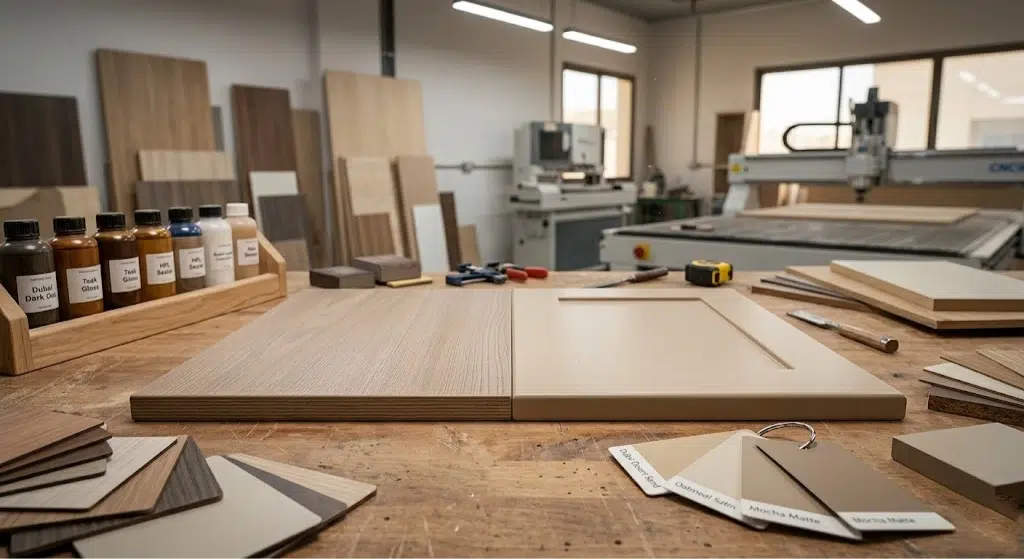
MDF (medium-density fibreboard) is denser and more stable than particle board, takes edge banding and routing cleanly, and is our primary substrate at Kustom Deco for wardrobe carcasses. When properly sealed on all sides and finished with quality laminate, MDF performs extremely well in UAE conditions. The key phrase is “properly sealed” cost-cutting manufacturers leave raw MDF edges exposed or use minimal edge banding, which is where moisture gets in.
Plywood is structurally superior to both, with genuine cross-grain strength that resists warping. We use it in structural components shelves under heavy load, base panels, internal frames. It’s more expensive than MDF, but for a wardrobe that’s going to last 15–20 years in a villa, it’s worth specifying.
Laminate Finishes for UAE Conditions
High-pressure laminate (HPL) is the professional standard for wardrobe exteriors in the UAE market. It’s hard, scratch-resistant, UV-stable, and handles temperature fluctuations well. The finish range has expanded enormously in recent years; you can achieve convincing wood-grain, stone-effect, and solid matt finishes in HPL that are difficult to distinguish from real materials at normal viewing distances. This makes it a premier choice for high-traffic wardrobes and cupboards and high-performance storage furniture.
Painted MDF (polyurethane lacquer) gives a flawless, seamless look that photographs beautifully and suits modern interiors, but it’s more vulnerable to chipping at corners. We use it for premium bedroom projects where the client wants a furniture-grade painted finish, but we always recommend reinforcing high-traffic areas with thicker lacquer applications.
Avoid: Foil-wrapped MDF (also called PVC wrap) in UAE conditions. It looks fine initially, but the adhesive bond between foil and substrate degrades in heat. Wardrobe interiors that hit 35–40°C during power outages or building maintenance shutdowns will start peeling within a few years. We’ve replaced enough of these to advise against them for anything intended to last.
Common Mistakes UAE Homeowners Make When Buying Wardrobes
We’ve been building furniture in this market for over 20 years. The following mistakes are not theoretical we see the consequences of them regularly.
Mistake 1: Measuring Only Once, at One Point
Already mentioned above, but worth repeating as its own point because it causes so much grief: UAE walls are not always plumb, floors are not always level, and ceilings are not always consistent. Measure width at the floor, at mid-height, and at the ceiling. Measure height at both ends and the middle. Use the smallest measurement as your reference. This one habit prevents the majority of installation headaches for your wardrobes and cupboards and storage furniture.
Mistake 2: Ignoring Ceiling Height When Ordering
Buying a 220cm wardrobe for a 270cm ceiling is a common error when people shop internationally or order from catalogues without accounting for UAE building standards. The visual gap looks disproportionate, but more practically as discussed above it becomes a serious dust management issue. Always specify height explicitly, even if it means going custom to get a floor-to-ceiling fit.
Mistake 3: Underestimating Storage Needs
UAE family households tend to be large. Extended family, live-in domestic staff, and a culture of generous hospitality mean wardrobes are worked hard. We consistently see clients who specified a 180cm wardrobe for a master bedroom and return six months later asking about expansion or a second unit for the dressing room. Build in 20–30% more capacity than you think you need. You will use it.
Mistake 4: Choosing Handles for Looks Over Function
This sounds minor, but in daily use it matters. Small, decorative handles on large, heavy sliding panels require real effort to move. Recessed J-pull handles the horizontal groove along the edge of a door require no protrusion and allow the full door face to be design-led. For wardrobes accessed multiple times daily by multiple family members, handle ergonomics genuinely affect daily life.
Mistake 5: Not Accounting for Door Clearance
This specifically applies to hinged wardrobes. Buying a wardrobe without checking that the bedroom layout allows full door swing is surprisingly common especially when people furnish rooms before all the other furniture arrives. A hinged wardrobe next to a bed requires a minimum of 50–60cm between the wardrobe and the side of the bed, or doors will either not open fully or hit the bed frame. Plan the whole room layout before committing.
Mistake 6: Trusting Online Images for Colour and Finish
Laminate colours and wood grain finishes look dramatically different on screen versus in person, and even more different under UAE home lighting conditions particularly the warm LED downlights that are standard in most Dubai apartments. Always request physical samples before ordering anything in a colour you haven’t seen in person. We send samples on request, and our Arjan showroom has full-scale displays in different finishes specifically because this matters.
Budget Guide: What to Expect in AED
Wardrobe pricing in Dubai spans an enormous range, and the gap between price points reflects genuine differences in material quality, hardware, customisation level, and manufacturer margin. Here’s how the market breaks down from our experience:
Entry Level (AED 1,500 – 4,000): Ready-made units from mass retailers. Particle board construction, basic laminate or foil wrap, standard hardware. Fine for temporary use or secondary bedrooms. Not our recommendation for master bedrooms or long-term Dubai residents.
Mid Range (AED 4,000 – 9,000): Better ready-made or entry-level custom. MDF construction with improved laminate, better hardware, some configuration options. This is where quality starts to become meaningful. At Kustom Deco, our standard custom wardrobes full height, sliding doors, basic interior typically start around AED 5,500–7,000 for a 200cm width, depending on specification.
Premium Custom (AED 9,000 – 18,000): Full custom to precise measurements, premium laminate or lacquer finish, soft-close hardware throughout, tailored interior fittings. A master bedroom wardrobe in this range should last 15–20 years without meaningful degradation. For a 240–280cm width floor-to-ceiling build with full interior fit-out, AED 11,000–15,000 is realistic from a quality UAE manufacturer.
Villa-Scale Projects (AED 18,000+): Walk-in wardrobes, multiple-room fit-outs, dressing rooms with integrated lighting, custom joinery. Pricing is project-specific.
What drives cost up: Mirror panels, integrated lighting, lacquer finish over laminate, soft-close hardware on every component, drawer banks, custom interior modules (jewellery inserts, tie racks, pull-out ironing boards).
The DTC advantage: As a direct manufacturer, Kustom Deco designs, builds, and delivers without distributing through retailers. That removes one layer of margin from the price typically 20–35% in the furniture retail sector. It means equivalent quality costs less, or you get better quality at the same budget compared to buying through a showroom that sources from third-party manufacturers.
Expert Tips from 20+ Years of UAE Furniture Making
These are the insights you only accumulate by spending two decades building furniture for this specific market.
1. Choose Hinge Brands, Not Just “Soft-Close”
Always ask which hinge brand is being used. Soft-close hinges vary widely in quality and price (AED 8–45 each). Cheap ones often fail within 18 months of heavy use. Prefer trusted German brands like Blum or Hettich. If the manufacturer cannot name the hinge brand, that tells you a lot.
2. Add Interior Lighting During Manufacturing
LED strip lighting inside wardrobes greatly improves usability, especially in UAE bedrooms with blackout curtains and darker interiors. It is inexpensive when added during production, but costly and inconvenient to retrofit later. Install it during the build stage.
3. Check Edge Banding Thickness
Edge banding is the strip that covers exposed MDF panel edges. Cheap wardrobes often hide poor quality here. Standard thickness is 0.4–0.8mm, while better quality is 2mm. Thicker edge banding lasts longer, especially around corners and doors over a 10-year period.
4. Plan for Future Expansion
If you may later add a second wardrobe or dressing area, mention it now. Matching finishes and creating logical connection points costs little during design, but retrofitting later often leads to visible mismatches.
Performance, Access & Timing
5. Ventilation Is Important in UAE Climate
Closed wardrobes in Dubai can trap heat and humidity. Damp laundry, shoes, or ambient moisture may create mildew inside. Use louvred panels, ventilation slots, or avoid sealing the top fully. This matters most in older buildings and ground-floor apartments.
6. Don’t Compromise on Drawer Runners
Drawer runners handle daily wear. Use full-extension, soft-close systems from reliable brands like Hettich Quadro or Blum Tandembox, built for around 30,000 cycles. Cheap runners fail early, and broken drawers are highly inconvenient.
7. Check Delivery Access First
A wardrobe may look perfect on paper but fail to fit through lifts, stairs, or doors. Measure lift size (many Dubai apartment lifts have 80cm openings), stairwells, and bedroom doors. Any oversized section should be designed in parts for on-site assembly.
8. Use Renovation Timing to Save Money
If timing is flexible, January–March and May–June are usually quieter months for Dubai custom furniture makers, with better availability and sometimes pricing flexibility. Avoid September–November if you need fast delivery, as it is peak renovation season when many expats return after summer.
Conclusion: Your Next Step
Buying a wardrobe in Dubai becomes much easier once you understand the local realities: non-standard alcove sizes, climate impact on materials, higher ceilings, and why custom wardrobes often outperform ready-made options in permanent homes.
The simple approach is to measure carefully at multiple points, choose MDF or better materials with quality laminate, and select a layout that matches your lifestyle and storage needs. If you plan to stay in your home for more than two or three years, custom wardrobes usually make better long-term financial sense for wardrobes, cupboards, and storage planning.
Key Takeaways
Measure Properly
Measure alcove width at three different heights, not only at floor level. Walls in UAE homes are often uneven, so one measurement is rarely enough.
Understand Ceiling Height Gaps
Most standard ready-made wardrobes are around 220cm tall, while many Dubai apartment ceilings are 270cm or higher. This leaves an unattractive gap that collects dust.
Choose Better Materials
MDF with strong edge banding and HPL laminate performs better in UAE climate conditions than particle board or foil wrap finishes.
Compare Custom Pricing
Custom wardrobes from direct manufacturers are often much closer in price to mid-range ready-made wardrobes than many buyers expect.
Specify Hardware Brands
Ask for trusted hardware brands such as Blum or Hettich, not just “soft-close.”
Why It Matters
The quality difference becomes clear over 5–10 years of daily use.
Ready to Put This Into Action?
At Kustom Deco, we’ve been building wardrobes and bedroom furniture for UAE homes for over 20 years—not importing, not reselling, but building. Every wardrobe we produce is designed around your specific space, ceiling height, lifestyle, and budget. We visit your home, take accurate measurements, present a design, and build to it. Our Arjan showroom has full-scale displays across different finishes and configurations so you can see exactly what you’re ordering before any commitment, ensuring your wardrobes and cupboards and bedroom sets are built to your exact vision.
If you have a wardrobe project in mind even if you’re still at the “thinking about it” stage the quickest way to get started is a WhatsApp message with your basic dimensions and a rough idea of what you need. We respond fast, and site visits across Dubai are complimentary.
Shop Online: skyblue-fish-879925.hostingersite.com/ Visit Showroom: Arjan – Al Barsha South, Dubai (Saturday–Friday, 10am–8pm) WhatsApp: +971 58 958 3686 (quickest response) Call: +971 4 570 4540 Email: info@kustomdeco.ae
Frequently Asked Questions (FAQs)
Most Dubai apartment alcoves range between 160cm to 280cm in width, with 180cm and 240cm being common. Depth should be at least 60–65cm for proper hanging, and full-height wardrobes (up to 270cm) are recommended to avoid dust gaps.
Yes, for long-term use and non-standard spaces, custom wardrobes are usually better. They fit perfectly, utilize full height, and are designed for your lifestyle. Ready-made works for temporary or budget setups.
Frequent temperature and humidity changes due to AC cycles cause expansion and contraction. Low-quality materials like particle board or foil finishes can swell, peel, or degrade over time.
MDF with proper sealing and high-pressure laminate (HPL) finish is the most reliable option. Plywood is even stronger for structural parts. Avoid foil-wrapped MDF for long-term use.
Sliding doors are ideal for apartments due to limited space. Hinged doors are better for larger villa bedrooms where full access and a classic look are preferred.
Typically, most custom wardrobe are delivered within 4-6 weeks. This timeframe includes both manufacturing and professional installation.
Measuring only once, ignoring ceiling height, underestimating storage needs, and choosing low-quality materials or hardware are the most common and costly mistakes.
Kustom Deco – Where Every Great Day Begins with a Good Night’s Sleep.
Contact us today: Phone: +97145704540 | Email: contact@kustomdeco.ae/