Blogs

How to Choose the Right Sofa for Your UAE Home: Size, Fabric, Configuration & Budget

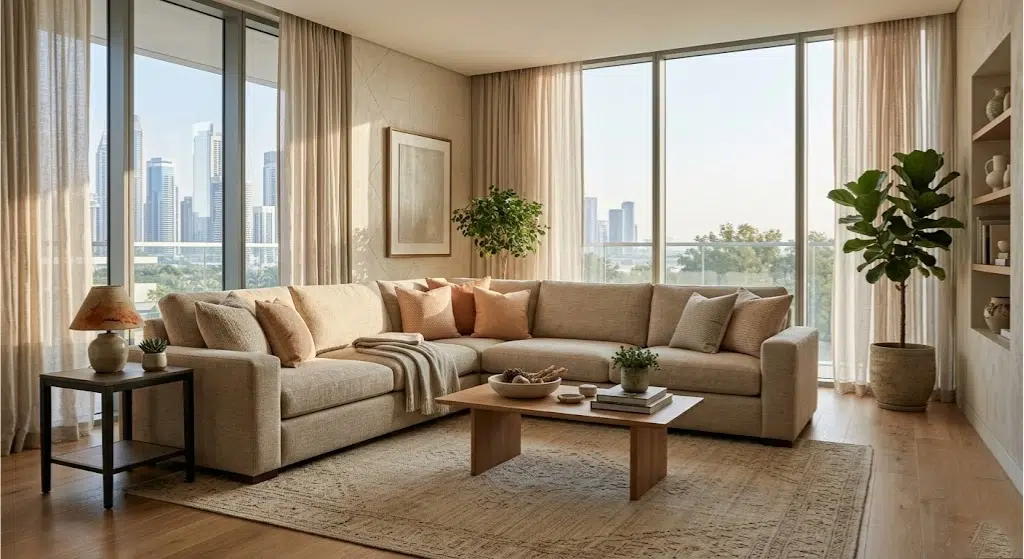
Sofa buying guide UAE — custom sectional sofa in a modern Dubai living room

Buying a sofa in the UAE is genuinely more complicated than most people realise and not because the options are limited. It’s because the wrong sofa in a Dubai apartment or Abu Dhabi villa doesn’t just look off. It fades, sags, sweats in the heat, or simply refuses to fit through the service entrance. After more than 20 years building furniture specifically for this market, we’ve seen every version of that mistake.

This guide exists because most sofa-buying advice online was written for temperate climates, average-sized Western living rooms, and customers who can walk into a local store and sit on what they’re buying. That’s not your reality here. We’ll walk you through exactly what matters when choosing a sofa for a UAE home size, fabric performance in this climate, configuration, and what you should realistically expect to spend at different quality levels.


Getting the Size Right: The Mistake That’s Hardest to Fix

Size is where most UAE sofa purchases go wrong, and it’s the one mistake you can’t really fix after delivery. Returning or exchanging a large sofa here is expensive and slow. Getting it right the first time requires thinking about three separate dimensions: the room, the sofa itself, and the access route.

Measure the Room, Then Measure Again

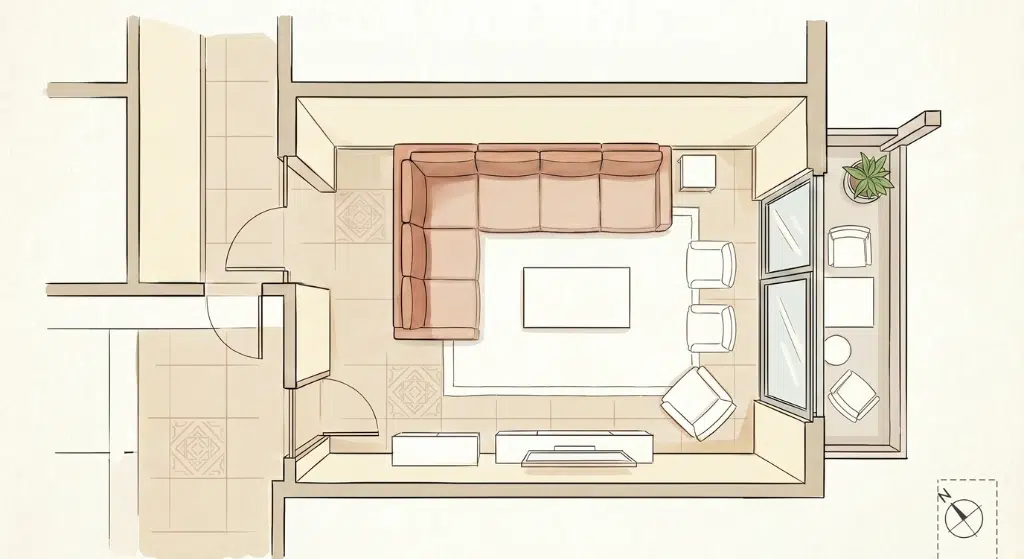
The rule most designers use is that your sofa should occupy no more than two-thirds of the wall it sits against, and there should be at least 90cm of clear walkway between the sofa and the nearest coffee table or opposing furniture. In practice, UAE apartments particularly studios and one-bedrooms in buildings like those across JLT, Dubai Marina, and Business Bay often have living areas that run between 18 and 28 square metres. That’s not small by global standards, but it leaves very little margin when you factor in a dining area that bleeds into the same open space.

In a standard Dubai Marina one-bedroom apartment with a combined living and dining layout, a three-seater sofa at 220–240cm wide is typically the maximum you can go before the room starts to feel compromised. A 260cm sofa in that same space will work against you every day it’ll block sightlines, interrupt traffic flow, and make the room feel smaller rather than grander.

Villa living rooms are a different story. In Arabian Ranches, The Springs, or Mirdif, ground-floor living rooms commonly run 40–60 square metres or more, and L-shaped or U-shaped sectionals make genuine sense. The challenge there shifts from fitting the sofa in the room to choosing proportions that don’t leave it floating in the middle like a raft.

Sofa size planning for UAE apartment — floor plan showing ideal placement dimensions

The Access Problem Nobody Mentions Until Delivery Day

This is the conversation we have with customers more often than any other: the sofa you chose fits the room perfectly but won’t physically enter the building. Older residential towers across Deira, Bur Dubai, and even mid-range buildings in newer areas often have service lifts that max out at 200cm in their longest internal dimension. Some have staircases with tight 90-degree turns at each landing.

Before you confirm any sofa purchase above 200cm, measure your service lift interior not the door opening, but the internal dimensions. Then check whether the sofa can be delivered as separate components. At our workshop, we build larger pieces in sections specifically for this reason, with concealed joinery that holds firm once assembled on-site. If you’re buying from a retailer who ships one solid frame, this is a question worth asking explicitly.

Seat Depth: Comfort Varies by How You Actually Sit

Standard sofa seat depth runs between 55 and 65cm. That range sounds narrow, but it makes a substantial difference depending on your height and how you typically use the sofa. If you sit upright which is more common when entertaining in a majlis-influenced layout a shallower depth of 55–58cm works well and keeps posture natural. If you use your sofa primarily to lounge, watch television, or relax after work, 62–68cm gives you room to sit back fully without your legs dangling.

Families with mixed heights particularly households where grandparents or shorter adults use the sofa regularly benefit from a middle-ground depth of around 60cm combined with a slightly firmer cushion that doesn’t swallow smaller frames.


Choosing Fabric for the UAE Climate: What Actually Holds Up

This is where the local knowledge matters most. The UAE’s climate is not just hot it’s a specific combination of intense UV exposure, air conditioning that cycles on and off throughout the day, and summer humidity that can spike above 80% in coastal areas between June and September. Each of those factors interacts with fabric differently.

Performance Fabrics: The Category That’s Changed Everything

Five years ago, performance fabrics were marketed primarily for households with children or pets. That framing undersells them significantly in the UAE context. Performance fabrics typically woven with solution-dyed acrylic, polyester, or olefin yarns resist UV fading, repel moisture, clean with a damp cloth, and don’t pill or flatten under regular use.

In our workshop, we’ve seen standard linen and cotton blends installed in west-facing villa majlis rooms fade noticeably within 18 months due to direct afternoon sun even through tinted glass. The same sofa in a performance weave will look the same in year four as it did on delivery day. For any sofa that receives even partial direct sunlight a common situation in Dubai’s open-plan villas performance fabric isn’t a premium add-on. It’s the sensible base choice.

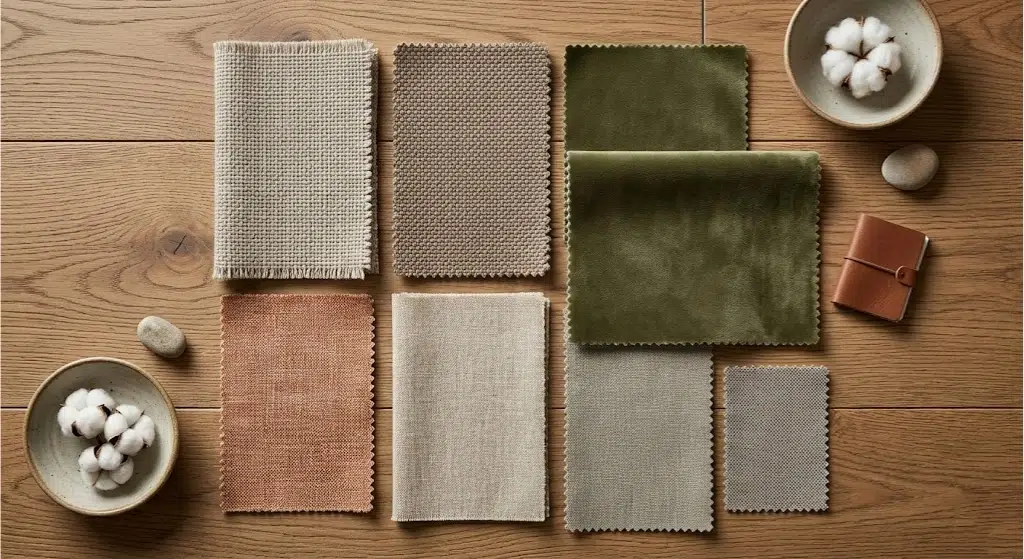
Sofa fabric options for UAE climate — performance, velvet, and linen swatches comparison

Velvet in the UAE: Honest Assessment

Velvet sofas are extremely popular right now, and for good reason they photograph beautifully and have a richness that most other fabrics can’t match. The honest assessment for the UAE, though, is nuanced.

Crushed velvet and cheap cut velvet crush and flatten in a matter of months under regular use, and they don’t recover well in humid conditions. High-quality performance velvet woven with a tighter pile density and a backing that maintains structure performs considerably better and is what we recommend if the look is important to you. Budget for proper velvet. If you’re looking at a velvet sofa below AED 4,500, the pile quality is almost certainly not up to this climate.

Leather and Faux Leather: What the Brochures Don’t Tell You

Full-grain leather ages beautifully in stable conditions, but UAE air conditioning particularly in apartments where units run cold and dry can dry leather out and cause cracking within two to three years without consistent conditioning. If you want leather, budget for genuine full-grain (not bonded or bi-cast) and factor in the ongoing maintenance. PU and faux leathers are worse, not better: the base layer delaminates in UAE humidity and typically starts to peel within 18–24 months of regular use.

Semi-aniline leather with a protective top coat is our recommendation if you’re committed to the leather aesthetic it handles the climate better than pure aniline while still having a natural look.

Linen and Linen Blends

Linen is breathable, natural, and looks at home in both contemporary and more traditional UAE interiors. Its weakness here is that it absorbs humidity, which can cause slight puckering or softening in coastal areas during summer months. It also stains more readily than performance alternatives, which matters in family households. In a cooler inland property or a predominantly air-conditioned space with minimal direct humidity exposure, linen performs well. Near the coast or in a busy family room, it’s a higher-maintenance choice.


Configuration: L-Shape, Modular, or Classic?

The configuration question depends primarily on how your living space is actually shaped and used not on what’s currently trending.

L-Shaped Sofas

L-shaped sofas work best when you have a clearly defined corner to anchor them in, a room large enough that they don’t dominate, and a household that genuinely uses the chaise or long section rather than leaving it empty. In UAE villas with large, square living rooms, they’re excellent. In rectangular apartment living rooms where they push one end of the L into the dining area or walkway, they create more problems than they solve.

One thing we see often in Dubai apartment renovations: people buy an L-shape because it looks impressive, then live with an awkward traffic flow for years. Measure the corner-to-wall clearance on both sides before committing. You need at least 30–40cm of breathing room beyond the sofa end to avoid the room feeling blocked.

Modular Configurations

Modular systems where individual units connect in various arrangements offer genuine flexibility for UAE residents who move apartments every two to three years. You can reconfigure for a new space without buying new furniture. The trade-off is that the connection points between modules, if they’re not engineered well, can shift or separate under regular use. From our manufacturing experience: the quality of the bracket and channel system that joins modules is the most important factor to examine before purchasing. Poorly engineered modulars loosen within a year.

Classic Two or Three-Seater with Accent Chair

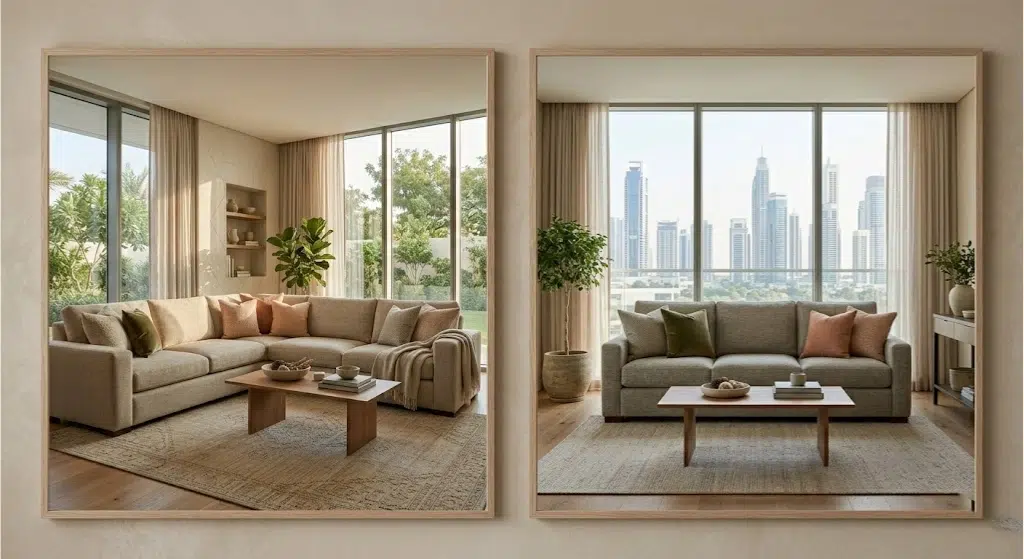
Often underrated. For apartments and smaller living rooms, a well-proportioned three-seater with an accent chair or two gives you significant layout flexibility, keeps sightlines open, and is dramatically easier to move and reconfigure. If you entertain formally, this arrangement also photographs and functions better than a single large sectional crowded into a smaller space.

Sofa configuration comparison — L-shape vs classic three-seater for UAE homes

Common Mistakes UAE Homeowners Make When Buying a Sofa

Mistake 1: Buying Without Measuring the Access Route

Covered earlier, but worth repeating: this is the most common and most expensive mistake. Delivery teams will attempt assembly in the corridor or car park when a piece doesn’t fit, and the results are rarely good. Measure your lift interior and any tight stairwell turns before you confirm the order.

Mistake 2: Choosing Fabric Based on How It Looks in a Showroom

Showrooms are air-conditioned to near-perfection. Fabrics that look and feel wonderful at 22°C in a controlled retail environment behave very differently in a west-facing apartment that heats up between noon and 4pm, or a villa entrance hall that gets direct sun through a glass door. Always ask about UV performance ratings and whether the fabric has been tested for colour fastness.

Mistake 3: Buying Based on Trend, Not Lifestyle

Boucle, lime wash, and fluted legs are beautiful. They’re also high-maintenance in households with children, regular guests, or pets. We see this pattern repeatedly: customers buy a statement sofa based on a social media aesthetic, then live with the anxiety of protecting it. Think honestly about your household. A sofa that suits your life and lasts ten years is worth more than one that suits a photoshoot and starts looking tired in two.

Mistake 4: Underestimating Lead Times for Custom Pieces

Ready-made sofas from large retailers can ship in days. Custom and made-to-order sofas where you choose the frame, fabric, configuration, leg finish, cushion firmness, and dimensions take longer. In our workshop, production runs 3 to 5 weeks for most residential pieces depending on complexity and current order volume. International custom orders can run 8 to 12 weeks or more. If you’re fitting out an apartment before a move-in date, order early and confirm production timelines in writing.

Mistake 5: Ignoring Frame Construction

The frame is the sofa’s skeleton. It determines whether the piece holds its shape for five years or starts to creak, bow, and slump in two. Kiln-dried hardwood frames are the benchmark. Plywood frames are acceptable if the grade is high. Particleboard frames common in budget sofas absorb humidity, swell, and weaken, which is particularly problematic in the UAE’s climate swings. Ask specifically what the frame is made from and whether the joints are glued, bracketed, and dowelled rather than stapled alone.

Mistake 6: Overlooking Cushion Construction

What your sofa feels like in a showroom on day one is not what it will feel like in 18 months if the cushion fill is low-quality. Cheap polyester fibrefill compresses quickly and doesn’t recover. High-density foam with a fibre wrap holds its shape and bounce significantly longer. HR (high resilience) foam is the industry standard worth asking for. Feather-wrapped cushions feel luxurious initially but require regular plumping and don’t suit every household’s maintenance appetite.


Budget Guide: What to Expect in AED

The UAE furniture market spans an enormous price range, and the variation in quality at different price points is real and significant.

Entry Level: AED 2,000 – 5,000 Mass-produced sofas, typically imported flat-pack or ready-assembled from large regional retailers. Frames are often particleboard or low-grade plywood. Fabrics are standard polyester or low-pile microfibre. These sofas serve a purpose short-term rentals, first apartments, furnished rooms but expecting them to last five or more years under regular use in the UAE climate is optimistic. No real customisation available.

Mid-Range: AED 5,000 – 12,000 This is where the market becomes more interesting and where most UAE homeowners investing in a longer-term piece should be looking. You start to find solid plywood frames, better cushion construction, and fabric choices that include performance options. Some customisation available on size and fabric from select suppliers. Quality is variable at this level the difference between AED 6,000 spent wisely and AED 6,000 spent poorly is significant, so frame and cushion questions matter here more than at any other tier.

Upper Mid: AED 12,000 – 25,000 Proper hardwood or high-grade plywood frames, high-density cushioning with HR foam, meaningful fabric libraries, and genuine customisation on dimensions, configuration, and detailing. This is where custom manufacturing in Dubai building the sofa to your exact specifications starts to make clear financial sense compared to importing. Lead times are longer but the piece is built for your specific space. A sofa at this level, properly cared for, should realistically last 10–15 years.

Bespoke: AED 25,000 and above Fully custom frames built to your floor plan, premium fabric imports, handfinished details, feather-and-foam cushion combinations, and full maker accountability if anything needs adjustment. This category is primarily villas, penthouses, commercial hospitality, and clients who want a furniture piece as part of a broader design vision. Delivery and installation are coordinated, not just dropped at the door.

From our workshop: The single best value decision in the mid-to-upper range is choosing a DTC (direct-to-consumer) manufacturer over a retailer stocking imported pieces. When you cut out the importer, distributor, and retail margin, AED 12,000 spent with a local manufacturer genuinely buys what AED 18,000–22,000 would through a conventional retail chain.


Expert Tips from 20+ Years of UAE Furniture Making

1. Order a fabric swatch and live with it for a week. Tape it to your sofa or wall at home. See it in the morning light from your windows, in artificial evening light, in direct sun if applicable. Fabric colours read completely differently in UAE residential light versus retail lighting.

2. Ask your manufacturer where the sofa will be assembled. Pieces built in the room they’ll occupy rather than assembled outside and maneuvered in arrive in better condition and give the maker a chance to verify fit, balance, and levelness on your actual floor.

3. Specify your cushion firmness explicitly. ‘Medium’ means different things to different workshops. Ask for the foam density in kg/m³. For a seat cushion, 32–36 kg/m³ is a comfortable standard. Below 28 and you’ll feel the base within a year.

4. Account for leg height when planning around rugs. In UAE homes with marble or tile flooring the majority the relationship between sofa leg height, rug thickness, and coffee table height determines how grounded the whole seating area feels. Short legs on thick tile can look heavy and dated. Taller legs, even by 5–8cm, visually lift the piece.

5. Think about cleaning access under the sofa. With Dubai’s dust and the prevalence of open windows in cooler months, the space beneath sofas accumulates dust quickly. Legs that give at least 12–15cm of clearance make cleaning genuinely easier and keep your home’s air quality better.

6. For multi-storey villas, consider building different sofa heights per floor. Ground floor majlis or formal sitting rooms often suit lower-profile sofas in the 38–42cm seat height range. Upper-floor family TV rooms can benefit from a higher, deeper sofa in the 44–48cm range that supports longer sitting sessions.

7. Confirm colorfastness specifically for window-facing sides. The back panel of a sofa facing a window receives the most UV exposure. Ask whether the fabric is solution-dyed (colour runs through the yarn) or surface-printed (colour sits on top). Solution-dyed fabrics hold their colour dramatically better under UV.

8. Request a written specification sheet before you sign off. Frame material, cushion foam density, fabric grade, leg finish, overall dimensions get it documented. It protects you if something arrives incorrect and gives you reference information for any future repairs or fabric replacement.


Conclusion: Your Next Step

Choosing the right sofa for a UAE home isn’t difficult when you know what to focus on and the four things that matter most are: size relative to your actual room and access route, fabric that genuinely suits this climate rather than just looking good in a showroom, a configuration that matches how your household actually lives, and a budget that aligns with how long you expect to own the piece.

The biggest regrets we hear from customers aren’t about spending too much. They’re about buying quickly, buying on trend, or buying without asking the questions that only an experienced maker would know to answer honestly.

Key Takeaways:

  • Measure your service lift and access route before confirming any sofa longer than 200cm
  • Performance fabrics are not just for households with children in UAE conditions, they’re the smart default choice
  • For rooms under 30m², a well-proportioned three-seater often outperforms a sectional both functionally and visually
  • HR foam (32–36 kg/m³ density) in cushions is the benchmark worth asking for at any price point
  • DTC manufacturing in Dubai offers significantly better value per dirham than the equivalent retail spend

Ready to Put This Into Action?

At Kustom Deco, we’ve spent over 20 years building furniture specifically for UAE homes apartments in JBR, villas in The Meadows, commercial spaces across Downtown Dubai. Every sofa we make is fully customisable: frame, configuration, dimensions, fabric, cushion construction, leg finish. You tell us what your space needs. We build it. If you’re in the planning stage, our team is genuinely happy to advise without any obligation it’s the kind of conversation that makes the final decision considerably easier.

Shop Online: kustomdeco.ae Visit our Showroom: Arjan – Al Barsha South, Dubai (Sat–Fri, 10am–8pm) WhatsApp: +971 58 958 3686 (quickest response) Email: info@kustomdeco.ae | Phone: +971 4 570 4540

Related Posts:

  • The Complete Guide to L-Shaped Sofas in UAE Apartments
  • Fabric vs Leather Sofa: Which is Right for Dubai’s Climate?
  • How to Plan a Living Room Layout in a UAE Villa
  • Custom vs Ready-Made Furniture in Dubai: A Honest Comparison

Frequently Asked Questions (FAQs)

1. What sofa size is best for a UAE apartment?

For most UAE apartments, especially in Dubai Marina, JLT, and Business Bay, a three-seater sofa between 220–240cm wide is usually the safest choice. It offers comfortable seating without overwhelming the room or blocking movement.

2. Why are performance fabrics recommended for UAE homes?

Performance fabrics handle the UAE climate much better than standard fabrics. They resist UV fading, humidity, moisture, and regular wear, which makes them a practical long-term choice for homes with sunlight exposure or frequent use.

3. Is velvet a good sofa fabric for Dubai and Abu Dhabi homes?

Yes, but only if it is high-quality performance velvet. Cheap velvet tends to flatten and lose its appearance quickly in humid conditions. For UAE homes, better velvet quality is essential if you want both durability and luxury.

4. Should I choose an L-shaped sofa or a classic three-seater?

It depends on your room layout. L-shaped sofas work well in spacious villas and larger living rooms, while a classic three-seater with accent chairs is often the smarter option for smaller apartments because it keeps the layout more flexible and open.

5. What is the biggest mistake people make when buying a sofa in the UAE?

The most common mistake is not measuring the access route before ordering. A sofa may fit the room perfectly but still fail to fit inside the service lift, stairwell, or apartment entrance.

6. What cushion quality should I look for in a sofa?

A good benchmark is HR foam with a density of 32–36 kg/m³. This provides better shape retention, comfort, and durability compared to low-quality foam or cheap fibre filling.

7. How much should I budget for a quality sofa in the UAE?

A decent long-term sofa usually starts in the AED 5,000–12,000 range, while better custom and upper mid-range sofas often fall between AED 12,000–25,000 depending on frame quality, fabric, and configuration.

Kustom Deco – Where Every Great Day Begins with a Good Night’s Sleep.

Contact us today: Phone: +97145704540 | Email: @kustomdeco.ae

Leave a Reply

Your email address will not be published. Required fields are marked *