Blogs
How to Choose a Sectional Sofa for a UAE Living Room: Size, Shape & Fabric -2026

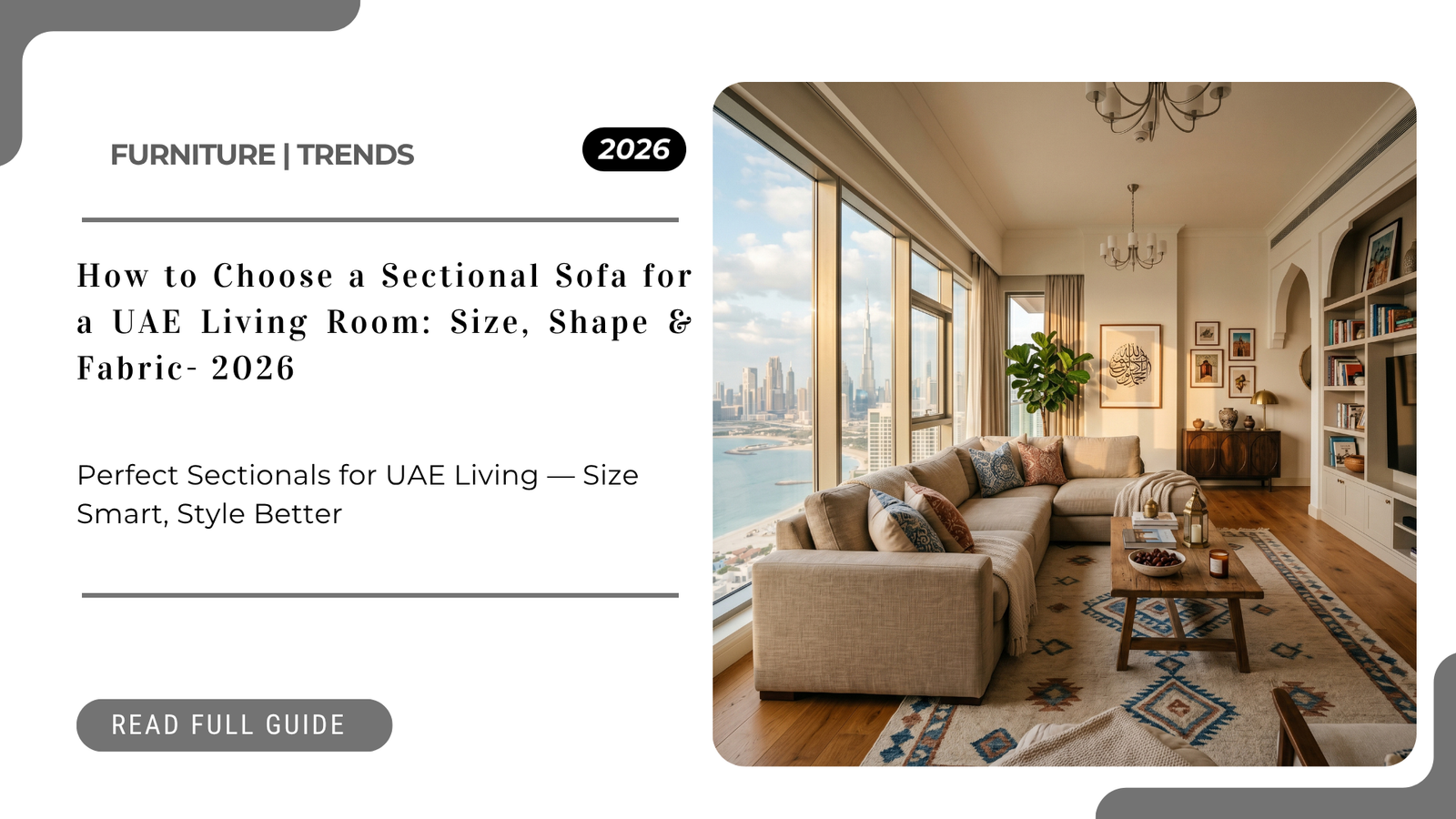
You found a sectional sofa online that looks perfect exactly the right length, clean lines, a fabric that photographs beautifully. You order it. Six weeks later it arrives in Dubai, and that’s when the problems start: it’s three centimetres too long to clear the entrance corridor, the fabric starts pilling within a month in your air-conditioned apartment, and the L-shape points the wrong way for your layout. Sound familiar? We hear this story at least once a week in our showroom.
At Kustom Deco, we’ve been building furniture specifically for UAE homes from our Dubai workshop for over 20 years. We’ve upholstered sectionals for studio apartments in JBR, oversized U-shapes for villas in Al Barari, and everything in between. That experience the real measurements, the failed fabrics, the layout experiments is what this guide is built on.
By the time you finish reading, you’ll know exactly what size sectional your space can actually handle, which shapes work for which layouts, and which fabrics will last in the UAE climate versus which ones will disappoint you within a season.
Why Choosing a Sectional in the UAE Is Different From Anywhere Else
Most sofa-buying guides are written for European or American homes. They assume predictable room proportions, moderate humidity, and a temperate climate. Dubai, Abu Dhabi, and Sharjah don’t match any of those assumptions and choosing furniture without accounting for that is one of the most expensive mistakes UAE homeowners make.
The UAE climate is the single biggest differentiator. With average indoor humidity often oscillating between 40–70% during summer even with air conditioning running, and dust that enters even the best-sealed apartments, the materials you choose behave very differently here than in London or Toronto. Fabrics that photograph beautifully in a European showroom can fade, attract dust, or start sagging within 18 months in a Dubai apartment.
Then there’s the architectural reality. UAE apartments particularly in developments like Downtown Dubai, Business Bay, and Dubai Marina follow layouts optimised for the developer’s floor-plate efficiency, not for comfortable furniture placement. Open-plan reception areas sound generous until you measure the usable sofa zone. Villa living rooms, on the other hand, can be genuinely large but often have awkward structural columns or passthrough corridors that break the space in unexpected ways.
The Expat Renovation Cycle Matters Too
A large portion of UAE residents both expats and nationals furnishing investment properties are furnishing on a 3-to-5-year horizon. That changes the calculus. You want a sectional that looks excellent for that period, travels well or sells well, and doesn’t require specialist cleaning. Modular sectionals that can be reconfigured or extended when you move to a larger home are especially valuable in this market.
Finally, family living patterns in the UAE tend toward larger gatherings more frequently. Friday family lunches, regular guests from extended families, and the cultural importance of a properly furnished majlis or reception space mean that sectionals here genuinely need to seat 6–8 people comfortably not just look good in photos.m
Getting the Size Right: The Measurements Most People Get Wrong
The number one error we see and we see it constantly is people measuring their room and buying a sofa to fill it, rather than measuring the room and buying a sofa that works within it. Those are two very different exercises. A sectional should anchor the seating area without pressing against walls, blocking natural traffic paths, or making the room feel like a furniture warehouse rather than a home.
The Measurements That Actually Matter
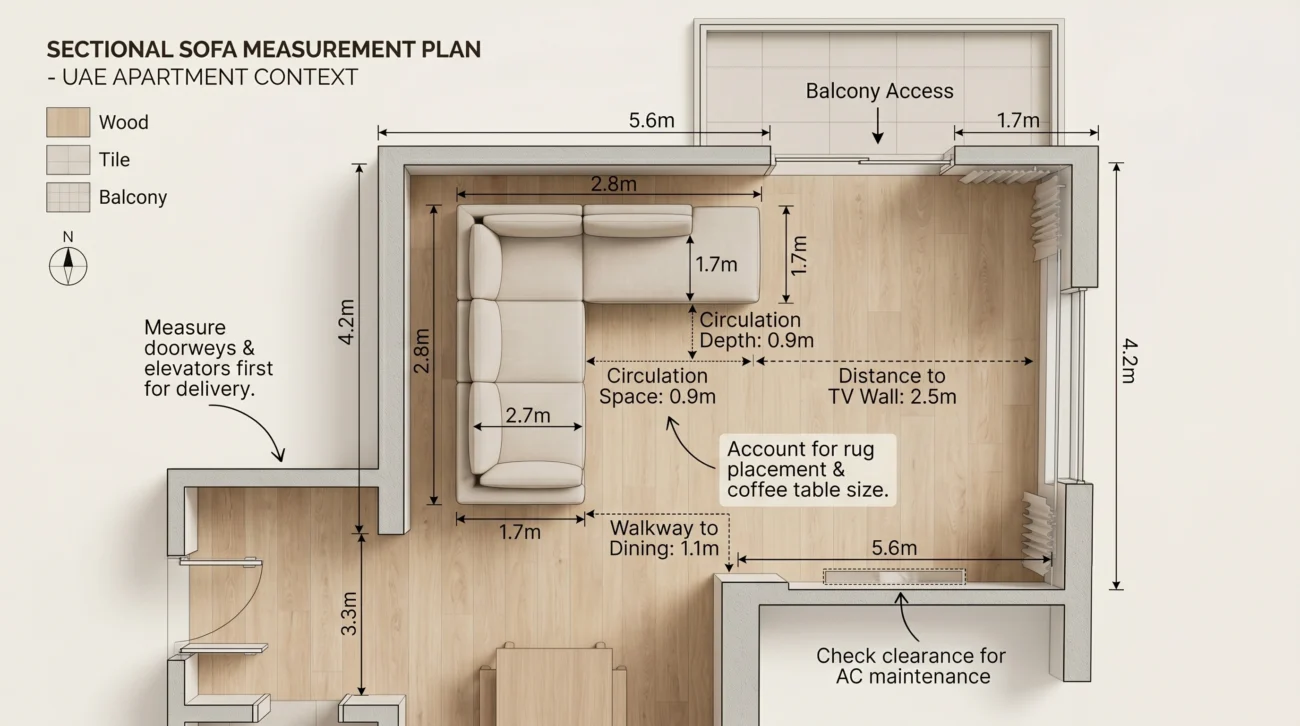
Before you look at a single sofa, take these six measurements and write them down:
- Total length of the room (wall to wall)
- Width of the room (wall to wall)
- The length of the “sofa wall” where the back or side of the sectional will sit
- Doorway width and corridor width leading to the living room (critical for delivery)
- Distance from the TV or focal point to where you want the sofa face to sit
- Any fixed obstacles: columns, air conditioning units, radiator panels, balcony doors
From these six numbers, you can work out your “sofa envelope” the maximum footprint your sectional can occupy while still leaving adequate circulation space. As a working rule from our experience: leave at least 90cm of clearance between any sofa arm and an adjacent wall or door, and at least 45cm of clearance between your coffee table and the sofa face.
UAE Apartment Realities: What Sizes Actually Work
We’ve furnished hundreds of Dubai apartments, and the sizing patterns are very consistent. Here’s what we see working and not working across common configurations:
Dubai Marina / JBR 1-Bedroom (typical living area: 4.5m x 4m) A small L-shape sectional in the 2.7m x 1.8m range is usually the maximum workable size. Anything larger starts eating into dining space or blocks the balcony flow. We typically recommend a 3-seater base with a 1.5m chaise, not a full corner sectional.
Business Bay / Downtown 2-Bedroom (typical living area: 5.5m x 4.5m) This is where an L-shape sectional genuinely works. A 3.2m x 2.2m configuration is comfortable. Some clients push to 3.5m x 2.4m that’s possible, but leave yourself the 90cm clearance rule or it will feel cramped regardless of how large the room is in theory.
Arabian Ranches / Springs Villa (typical living area: 7m x 6m+) These spaces handle U-shape sectionals and large modular configurations. A 4m x 3m sectional is often appropriate. The challenge here isn’t size it’s getting the proportions right so the sofa doesn’t float in the middle of too much floor space.
These are averages from real projects. Your specific layout will vary always measure your actual space and use masking tape on the floor to mock up the footprint before committing to anything.
The Delivery Reality Nobody Talks About
In 20 years of delivering furniture across the UAE, delivery access has caused more problems than any design decision. Before ordering any large sectional, measure every doorway, corridor, and lift between the building entrance and your apartment. Standard apartment lift doors in UAE high-rises are typically 90–100cm wide. Most elevator cars are 130cm deep. A sectional module larger than 85cm wide by 120cm long will not fit in most lifts it needs to come up via the stairwell.
If your building has a stairwell with standard 90-degree turns, anything over 220cm in a single piece becomes a significant delivery challenge. This is why modular sectionals pieces that separate cleanly at the connection points are so practical in the UAE market. At Kustom Deco, we design all our modular sectionals to break down into individually manageable pieces without compromising the final assembled look.
L-Shape, U-Shape, or Modular? Choosing the Right Configuration
Sectional sofas come in four practical configurations for UAE homes: the L-shape (the most common), the U-shape (the most generous), the chaise sectional (the most flexible), and true modular systems (the most adaptable). Each serves a different purpose and works in different space types.
L-Shape Sectionals
The L-shape is the workhorse of UAE living rooms for good reason. It defines a seating zone clearly, fits naturally into corners without wasting space, and works in rooms from about 4.5m x 4m upwards. The key decision with an L-shape isn’t the overall dimensions it’s whether the long arm should run left or right from your entry point. Get this wrong and you’ll fight the traffic flow through the room every single day.
A practical test: stand in your living room doorway and look in. Is the TV wall to your left or right? The short arm of the L should face the TV, and the long arm should run along the side wall. If the sofa configuration forces you to choose between these two orientations, the TV-facing side wins every time.
The L-shape also has a chaise variant, where one end extends as a longer reclining section without a second upright backrest. This is popular in 1 and 2-bedroom apartments where you want the comfort of a sectional without a full second arm cutting into the room.
U-Shape Sectionals
U-shape sectionals are exceptional for conversation everyone faces the centre, seating capacity is high, and the configuration creates an almost room-within-a-room feeling. They work best in villa living rooms and large reception areas, typically requiring a minimum usable zone of 5.5m x 5m to avoid feeling hemmed in.
The practical limitation: the middle section of the U faces directly inward, making it slightly less comfortable for TV watching than the two side arms. For families who entertain frequently and use the living room as a gathering space first and a TV room second, this trade-off is entirely worth it. For a couple using the living room primarily as a TV room, it often isn’t.
U-shapes also present a real delivery challenge three separate runs of seating need to pass through the same doors. Always confirm delivery logistics before ordering.
Modular Sectionals
Modular systems are the most versatile option and increasingly popular among UAE residents who move between apartments, rent, or simply want the option to reconfigure their living room without buying new furniture. A well-designed modular sectional can work as a large U-shape today, be reconfigured into two separate sofas when you move, or have pieces added when you upgrade to a larger home.
The quality test for modular systems is the connection mechanism. Cheap modular sofas use surface-level clips or no connections at all modules drift apart within weeks of use. Quality modular systems use interlocking brackets, aligned feet, and consistent seat height across all modules. In our workshop, we build modular connections with custom-fabricated brackets so that seat height and cushion alignment are precise across every module regardless of configuration.
Quick Reference: Which Configuration Works for Your Room?
| Configuration | Best For | Minimum Room Size |
|---|---|---|
| L-Shape | Apartments, mid-size open plans | 4.5m x 4m |
| Chaise L-Shape | 1–2BR apartments, TV-focused rooms | 4m x 3.5m |
| U-Shape | Villas, large reception rooms, entertainers | 5.5m x 5m |
| Modular | Renters, frequent movers, large families | Scales to space |
The Fabric Guide: What Actually Works in the UAE Climate
This is the section that will save you the most money. Fabric is the most common point of failure in UAE sofas not the frame, not the cushions, not the stitching. The fabric. And almost always because the buyer chose based on appearance rather than performance.
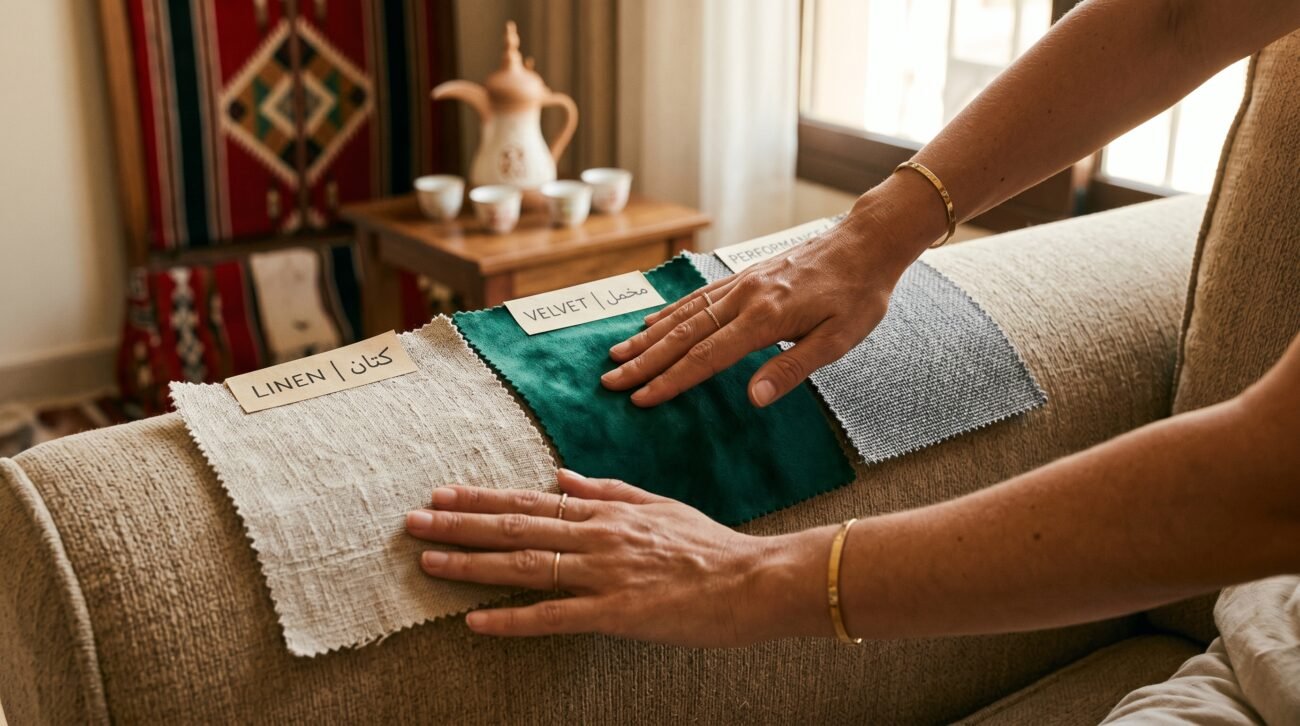
The UAE presents three simultaneous fabric challenges that almost no other market combines: intense air conditioning (which dries fabric and causes brittleness over time), high ambient humidity during summer months (which can cause mildew and odour in natural fibres), and fine desert dust that works into every weave and accelerates abrasion.
Linen and Linen Blends The Most Requested, The Most Misunderstood
Linen looks exceptional in photographs and has a genuinely beautiful texture and breathability. In a UAE home, pure linen is a mixed proposition. The breathability is a real advantage for comfort in an air-conditioned room. However, pure linen is highly susceptible to dust absorption that powdery Dubai haze that settles during the shamal season works deep into open-weave linen and is difficult to extract without professional cleaning.
Our recommendation: linen-polyester blends (70% linen, 30% polyester or similar) perform significantly better in UAE conditions than pure linen. The polyester component reduces the open weave slightly, making the fabric more dust-resistant and easier to clean, while preserving most of the natural linen aesthetic. It also reduces the wrinkling and creasing that pure linen is prone to during high-humidity periods.
Budget expectation for a custom linen-blend sectional: AED 8,500 to AED 18,000, depending on size and configuration.
Velvet is Better Than Its Reputation in the UAE
Velvet has a reputation in the UAE for being impractical, and in cheaper forms, that reputation is deserved. Budget velvet piles flatten under repeated use, show pressure marks and pet hair dramatically, and can develop a patchy appearance within 12–18 months in AC-heavy environments where the fabric dries and re-humidifies repeatedly.
Premium performance velvet is a different material entirely. Specifically, we use and recommend solution-dyed velvet with a tight pile count (300+ grams per square metre). This grade of velvet resists flattening, cleans easily with a damp cloth, and holds colour far better than standard velvet in UAE environments where UV exposure through glass can be intense, even with window tinting. It also handles the temperature differential of UAE living from 18°C indoors to 42°C outdoors without the cracking or stiffening that cheaper velvets exhibit.
Budget expectation for a custom premium velvet sectional: AED 12,000 to AED 24,000, depending on size.
Leather and Faux Leather
Genuine leather sofas in the UAE require more maintenance than most buyers anticipate. The combination of AC dryness and UV exposure from large windows causes genuine leather to dry and crack without regular conditioning every three months at minimum. Neglected leather in a UAE apartment can look a decade older than its actual age within two years.
Full-grain leather with a protective treatment performs best and can genuinely last 15–20 years with basic maintenance. Budget accordingly: a quality leather sectional starts at AED 18,000 and can run to AED 45,000+ for full-grain leather in large configurations.
Faux leather (PU leather) is popular in the AED 5,000–10,000 bracket and has improved significantly in quality. The primary failure mode in UAE is peeling and delamination the bonded layers separate in high heat and humidity cycles. If choosing faux leather, look specifically for a woven-base PU rather than a foam-base PU; the woven base holds up significantly better.
Performance Fabrics The Underrated Choice
Performance fabrics (often marketed as “easy-clean”, “stain-resistant”, or by brand names like Crypton or Revolution fabric) are, in our professional opinion, the most sensible choice for most UAE families. These are synthetic-based fabrics engineered for durability they resist staining, clean with water and mild soap, dry quickly, and don’t absorb dust the way natural fibres do.
The honest drawback is that cheaper performance fabrics can look slightly synthetic and feel marginally less luxurious than premium linen or velvet. Mid-to-high grade performance fabrics have closed this gap considerably. For families with young children, pets, or anyone who entertains frequently, the functional advantages outweigh the aesthetic trade-off entirely.
Budget: AED 7,000 to AED 16,000 for a standard L-shape sectional in mid-grade performance fabric.
Common Mistakes UAE Homeowners Make When Buying Sectionals
Mistake 1: Ordering Without Measuring the Delivery Path
We’ve mentioned this but it deserves its own spotlight because it’s genuinely the most painful mistake financially and logistically. We have seen brand-new, expensive sectionals left in building lobbies because they couldn’t fit in the lift and the stairwell was too narrow for the configuration. Measure every door, corridor, and lift before ordering. Always ask the supplier to confirm the individual module dimensions.
Mistake 2: Choosing Configuration Before Deciding Traffic Flow
Many buyers walk into a showroom, see a beautiful right-facing L-shape, and buy it, then discover that in their actual apartment, that configuration blocks the main entrance flow or turns the TV wall into dead space. Configuration (which way the L faces) is as important as size. Always mark your room’s traffic flow with tape on the floor before deciding.
Mistake 3: Buying Pure Natural Fabrics Without Understanding Maintenance
Pure linen, cotton velvet, and untreated natural fabrics look beautiful in showroom conditions. In a lived-in UAE home with AC cycling on and off, dust events, and children or pets, they require consistent maintenance that most buyers aren’t prepared for. Either choose performance-enhanced natural blends, or accept a maintenance schedule and budget for professional cleaning every 12–18 months.
Mistake 4: Underestimating Seat Depth
Standard sofa seat depth is around 55–60cm. Many sectionals aimed at the European export market have shallower seats, 48–52cm, which feel compact for a UAE family expecting to properly relax. For a sectional used daily by adults, 58–65cm seat depth is comfortable. If you’re taller than 180cm, lean toward 65cm or consider custom depth. We see this constantly in imported sofas that look proportional in photos but feel cramped the moment you sit in them for more than ten minutes.
Mistake 5: Ignoring Cushion Fill Quality
Frame and fabric get most of the attention. Cushion fill is what determines how the sofa feels in three years, not on day one. Cheap sectionals use low-density foam (under 30kg/m³) that compresses and dips within 12–18 months. Quality sectionals use high-resilience foam (35–40kg/m³), sometimes combined with a fibre wrap for a softer top feel. The difference in cost at the manufacturing level is relatively small. The difference in comfort after two years of daily use is dramatic. Always ask for the foam density specification before purchasing.
Mistake 6: Buying a Fixed Sectional When Your Situation Is Fluid
If you’re on a 2-year rental contract, furnishing a property you may leave, or in a household likely to change size, a fixed sectional that can’t be reconfigured is a significant commitment. Modular systems with proven connection hardware give you the option to adapt without buying new furniture. We’ve had clients in Dubai Marina who’ve reconfigured the same modular sectional three times across two apartments over five years far better value than buying and selling fixed pieces on the secondary market.
Budget Guide: What to Expect in AED
These are honest price ranges based on 20+ years of building and selling in the UAE market. They cover locally manufactured and custom-made sectionals; import prices vary significantly by brand and retailer markup.
| Budget Range | AED Range | What You Get |
|---|---|---|
| Entry Level | AED 3,500 – 6,500 | Fixed configuration, basic foam, import or mass-produced. Limited customization. Expect 3–5 year lifespan in heavy use. |
| Mid Range | AED 7,000 – 15,000 | Solid frame, HR foam, fabric choice, some customization. Good 7–10 year lifespan. Where most apartment buyers sit. |
| Premium | AED 16,000 – 32,000 | Kiln-dried hardwood frame, premium foam + fibre, full fabric customization, modular options. 12–20 year lifespan. Villa and serious apartment investment. |
| Luxury / Full Custom | AED 35,000+ | Kiln-dried hardwood frame, premium foam + fibre, full fabric customization, modular options. 12–20 year lifespan. Villa and a serious apartment investment. |
One factor worth understanding: buying directly from a manufacturer (DTC) versus through a retailer typically saves 25–40% on comparable quality. When you buy through a retail store, you’re paying for showroom space, import margins, and retail markup on top of the actual product cost. At Kustom Deco, we manufacture in Dubai and sell directly, which is why our pricing at each quality level tends to undercut comparable import brands significantly.
Typical lead time from order to delivery for a custom sectional from our workshop: 3–4 weeks for standard configurations, 5–6 weeks for complex custom specifications.
Expert Tips from 20+ Years of Making Furniture for UAE Homes
Test all seats before buying—corner, middle, and chaise can feel very different.
Choose kiln-dried hardwood frames (eucalyptus, beech) for durability in UAE humidity.
Ensure at least 12 cm leg height for easy cleaning under the sofa.
Prefer solution-dyed fabrics—they resist fading from strong UAE sunlight.
Go for removable, washable covers—essential for families and long-term use.
Stick to neutral colors (grey, stone, linen) for flexibility with changing trends.
Inspect the corner unit—it reveals alignment and overall build quality.
Match your coffee table: keep height within 3 cm of seat and a 40–50 cm gap for comfort.
Conclusion: Your Next Step
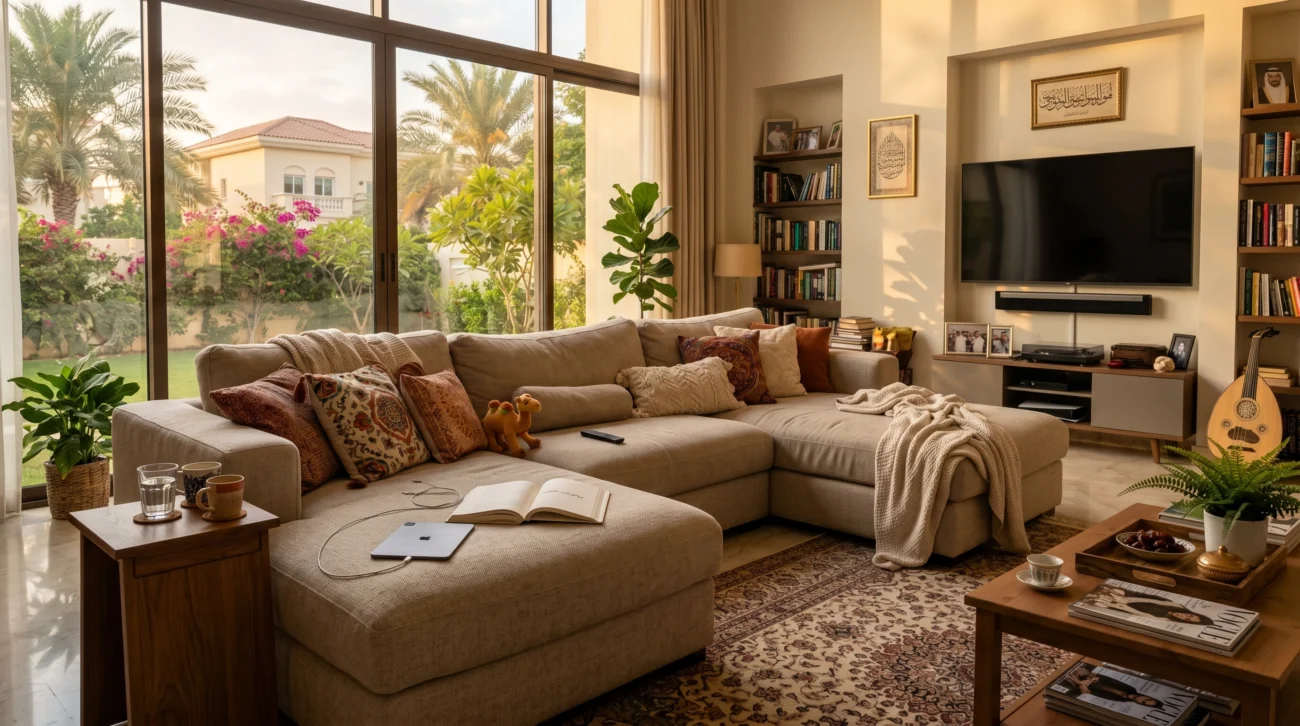
Choosing a sectional sofa in the UAE requires more than just picking a style. Climate, home layouts, and delivery constraints all matter—getting them wrong can lead to costly mistakes.
Start by measuring your delivery path, then your room. Choose a layout based on real usage and movement, not just looks. Pick fabrics that suit UAE conditions and your daily life, and invest in strong frames and quality cushions for long-term comfort.
Key Takeaways:
- Keep at least 90 cm clearance around the sofa for easy movement.
- Measure lift and entry sizes—module dimensions matter.
- Choose linen-polyester or performance fabrics over pure natural fibres.
- Look for 35–40 kg/m³ HR foam for lasting comfort.
- Modular sofas are ideal for flexibility and future changes.
Ready to Put This Into Action?
At Kustom Deco, we build every sectional to the exact dimensions your space needs not the dimensions that happen to fit a standard container. With our Dubai workshop producing directly for your home, you get full customization at prices that reflect DTC manufacturing, not retail markup. Bring your room dimensions to our showroom in Arjan – Al Barsha South and we’ll work through the options with you in person. Or get in touch on WhatsApp for a quick conversation before you visit.
Shop Online: kustomdeco.ae Visit Showroom: Arjan – Al Barsha South, Dubai | Sat–Fri, 10am–8pm WhatsApp: +971 58 958 3686 (quickest response) Phone: +971 4 570 4540
Related Posts:
- How to Style a Living Room Around a Large Sectional Sofa in a UAE Apartment
- Sofa Fabrics for Dubai Homes: The Complete 2026 Comparison Guide
- Open-Plan Living Room Furniture Layouts That Work in UAE Apartments
- How Long Should a Custom Sofa Take to Make? UAE Manufacturing Timelines Explained
Frequently Asked Questions (FAQs)
For most UAE apartments, a sectional between 2.7m to 3.2m works well. Smaller 1-bedroom spaces suit chaise sectionals, while larger 2-bedroom layouts can handle full L-shapes. Always measure your space and allow at least 90 cm clearance.
Performance fabrics and linen-polyester blends are ideal for UAE homes. They resist dust, humidity, and fading better than pure natural fabrics like linen or cotton.
Base your layout on room traffic flow and TV placement. L-shapes work best for most homes, while U-shapes suit larger villas. Modular sofas are best for flexibility and future changes.
Look for high-resilience foam between 35–40 kg/m³. This ensures your sofa maintains comfort and shape for years without sagging.
Not always. You must measure lift size, doorways, and corridors before ordering. Modular sectionals are easier to deliver because they come in smaller pieces.
A quality sectional typically ranges from AED 7,000 to AED 15,000 for mid-range options, while premium custom sofas can go up to AED 30,000 or more, depending on size and materials.
Kustom Deco – Where Every Great Day Begins with a Good Night’s Sleep.
Contact us today: Phone: +97145704540 | Email: contact@kustomdeco.ae